And the Sun Shall Rise Again
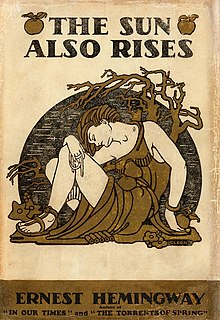
First edition of The Lord's day Likewise Rises, published in 1926 by Scribner's, with grit jacket illustrated by Cleonike Damianakes. The Hellenistic jacket design "breathed sex yet besides evoked classical Greece".[1]
The Sunday Too Rises is a 1926 novel by American writer Ernest Hemingway, his kickoff, that portrays American and British expatriates who travel from Paris to the Festival of San Fermín in Pamplona to watch the running of the bulls and the bullfights. An early and enduring modernist novel, it received mixed reviews upon publication. All the same, Hemingway biographer Jeffrey Meyers writes that it is now "recognized every bit Hemingway's greatest piece of work",[2] and Hemingway scholar Linda Wagner-Martin calls it his virtually important novel.[3] The novel was published in the United states in Oct 1926 by Scribner's. A twelvemonth after, Jonathan Greatcoat published the novel in London nether the title Fiesta . It remains in print.
The novel is a roman à clef: the characters are based on real people in Hemingway's circle, and the activeness is based on real events, specially Hemingway's life in Paris in the 1920s and a trip to Kingdom of spain in 1925 for the Pamplona festival and fishing in the Pyrenees. Hemingway presents his notion that the "Lost Generation"—considered to accept been decadent, dissolute, and irretrievably damaged by Earth War I—was in fact resilient and potent.[4] Hemingway investigates the themes of love and death, the revivifying power of nature, and the concept of masculinity. His spare writing style, combined with his restrained utilise of clarification to convey characterizations and activeness, demonstrates his "Iceberg Theory" of writing.
Groundwork [edit]
In the 1920s Hemingway lived in Paris every bit a foreign contributor for the Toronto Star, and traveled to Smyrna to report on the Greco–Turkish War. He wanted to use his journalism feel to write fiction, believing that a story could exist based on existent events when a writer distilled his own experiences in such a style that, according to biographer Jeffrey Meyers, "what he made up was truer than what he remembered".[5]

With his married woman Hadley Richardson, Hemingway starting time visited the Festival of San Fermín in Pamplona in 1923, where he was following his recent passion for bullfighting.[6] The couple returned to Pamplona in 1924—enjoying the trip immensely—this time accompanied by Chink Dorman-Smith, John Dos Passos, and Donald Ogden Stewart and his wife.[7] The two returned a third time in June 1925 and stayed at the hotel of his friend Juanito Quintana. That year, they brought with them a different group of American and British expatriates: Hemingway's Michigan boyhood friend Pecker Smith, Stewart, recently divorced Duff, Lady Twysden, her lover Pat Guthrie, and Harold Loeb.[8] Hemingway's memory spanning multiple trips might explain the inconsistent timeframe in the novel indicating both 1924 and 1925.[9] In Pamplona, the grouping apace disintegrated. Hemingway, attracted to Duff, was jealous of Loeb, who had recently been on a romantic getaway with her; by the end of the week the two men had a public fistfight. Against this background was the influence of the young matador from Ronda, Cayetano Ordóñez, whose brilliance in the bullring affected the spectators. Ordóñez honored Hemingway's wife past presenting her, from the bullring, with the ear of a balderdash he killed. Outside of Pamplona, the fishing trip to the Irati River (about Burguete in Navarre) was marred by polluted water.[eight]
Hemingway had intended to write a nonfiction book about bullfighting, but and then decided that the calendar week'southward experiences had presented him with enough material for a novel.[7] A few days after the fiesta ended, on his altogether (21 July), he began writing what would eventually become The Sun Also Rises.[ten] By 17 Baronial, with fourteen chapters written and a working title of Fiesta chosen, Hemingway returned to Paris. He finished the draft on 21 September 1925, writing a foreword the post-obit weekend and changing the title to The Lost Generation.[11]
A few months later, in December 1925, Hemingway and his wife spent the wintertime in Schruns, Austria, where he began revising the manuscript extensively. Pauline Pfeiffer joined them in Jan, and—against Hadley's advice—urged him to sign a contract with Scribner's. Hemingway left Austria for a quick trip to New York to run across with the publishers, and on his return, during a stop in Paris, began an matter with Pauline. He returned to Schruns to finish the revisions in March.[12] In June, he was in Pamplona with both Richardson and Pfeiffer. On their return to Paris, Richardson asked for a separation, and left for the south of France.[xiii] In August, alone in Paris, Hemingway completed the proofs, dedicating the novel to his married woman and son.[14] After the publication of the book in Oct, Hadley asked for a divorce; Hemingway subsequently gave her the volume's royalties.[15]
Publication history [edit]

Hemingway maneuvered Boni & Liveright into terminating their contract with him so that The Sun Also Rises could be published by Scribner'southward instead. In December 1925 he quickly wrote The Torrents of Jump—a satirical novella attacking Sherwood Anderson—and sent it to his publishers Boni & Liveright. His iii-volume contract with them included a termination clause should they reject a single submission. Unamused past the satire against 1 of their virtually saleable authors, Boni & Liveright immediately rejected it and terminated the contract.[16] Within weeks Hemingway signed a contract with Scribner's, who agreed to publish The Torrents of Spring and all of his subsequent work.[17] [note ane]
Scribner'south published the novel on 22 October 1926. Its first edition consisted of 5090 copies, selling at $ii.00 per copy.[eighteen] Cleonike Damianakes illustrated the grit jacket with a Hellenistic design of a seated, robed woman, her head bent to her shoulder, eyes airtight, one hand holding an apple, her shoulders and a thigh exposed. Editor Maxwell Perkins intended "Cleon's respectably sexy"[1] design to attract "the feminine readers who control the destinies of so many novels".[xix]
Two months later the book was in a second printing with 7000 copies sold. Subsequent printings were ordered; by 1928, after the publication of Hemingway'southward curt story drove Men Without Women, the novel was in its eighth printing.[20] [21] In 1927 the novel was published in the UK by Jonathan Cape, titled Fiesta, without the ii epigraphs.[22] Ii decades afterward, in 1947, Scribner'due south released three of Hemingway's works as a boxed set up, including The Sunday Also Rises, A Farewell to Arms, and For Whom the Bell Tolls.[23]
By 1983, The Sun Also Rises had been in print continuously since its publication in 1926, and was probable i of the well-nigh translated titles in the world. At that time Scribner'south began to print cheaper mass-market paperbacks of the book, in addition to the more than expensive trade paperbacks already in print.[24] In the 1990s, British editions were titled Fiesta: The Sun Besides Rises. [25] In 2006 Simon & Schuster began to produce audiobook versions of Hemingway's novels, including The Lord's day Too Rises.[26] In May 2022 a new "Hemingway Library Edition" was published by Simon & Schuster, including early drafts, passages that were deleted from the concluding draft, and alternative titles for the book, which help to explicate the author'southward journey to produce the final version of this acclaimed work.[27] [28]
Plot summary [edit]
On the surface, the novel is a love story betwixt the protagonist Jake Barnes—a man whose war wound has made him unable to accept sexual practice—and the promiscuous divorcée Lady Brett Ashley. Jake is an expatriate American announcer living in Paris, while Brett is a twice-divorced Englishwoman with bobbed hair and numerous honey affairs, and embodies the new sexual freedom of the 1920s. Brett's thing with Jake'due south college friend Robert Cohn causes Jake to be upset and suspension off his friendship with Robert; her seduction of the 19-year-old matador Romero causes Jake to lose his proficient reputation among the Spaniards in Pamplona.
Book One is gear up in the café society of young American expatriates in Paris. In the opening scenes, Jake plays tennis with Robert, picks upwards a prostitute (Georgette), and runs into Brett and Count Mippipopolous in a nightclub. Later, Brett tells Jake she loves him, but they both know that they have no chance at a stable relationship.
In Book Two, Jake is joined by Bill Gorton, recently arrived from New York, and Brett's fiancé Mike Campbell, who arrives from Scotland. Jake and Bill travel south and meet Robert at Bayonne for a fishing trip in the hills northeast of Pamplona. Instead of angling, Robert stays in Pamplona to look for the overdue Brett and Mike. Robert had an thing with Brett a few weeks earlier and still feels possessive of her despite her engagement to Mike. Later on Jake and Nib enjoy five days of fishing the streams near Burguete, they rejoin the group in Pamplona.
All brainstorm to drink heavily. Robert is resented by the others, who taunt him with antisemitic remarks. During the fiesta the characters drink, eat, picket the running of the bulls, attend bullfights, and bicker with each other. Jake introduces Brett to the 19-year-sometime matador Romero at the Hotel Montoya; she is smitten with him and seduces him. The jealous tension among the men builds—Jake, Mike, Robert, and Romero each desire Brett. Robert, who had been a champion boxer in higher, has a fistfight with Jake and Mike, and another with Romero, whom he beats up. Despite his injuries, Romero continues to perform brilliantly in the bullring.
Book 3 shows the characters in the aftermath of the fiesta. Sober once again, they leave Pamplona; Bill returns to Paris, Mike stays in Bayonne, and Jake goes to San Sebastián on the northern coast of Spain. Every bit Jake is about to return to Paris, he receives a telegram from Brett asking for help; she had gone to Madrid with Romero. He finds her there in a cheap hotel, without money, and without Romero. She announces she has decided to get back to Mike. The novel ends with Jake and Brett in a taxi speaking of the things that might have been.
Themes and analysis [edit]
Paris and the Lost Generation [edit]

The beginning book of The Sun Also Rises is ready in mid-1920s Paris. Americans were drawn to Paris in the Roaring Twenties past the favorable commutation rate, with as many as 200,000 English-speaking expatriates living at that place. The Paris Tribune reported in 1925 that Paris had an American Hospital, an American Library, and an American Chamber of Commerce.[29] Many American writers were disenchanted with the The states, where they plant less artistic freedom than in Europe. (For case, Hemingway was in Paris during the menses when Ulysses, written by his friend James Joyce, was banned and burned in New York.)[xxx]
The themes of The Sun Too Rises appear in its two epigraphs. The first is an allusion to the "Lost Generation", a term coined by Gertrude Stein referring to the post-war generation;[note 2] [31] the other epigraph is a long quotation from Ecclesiastes: "I generation passeth away, and some other generation cometh: just the earth abideth for always. The sun as well ariseth, and the lord's day goeth down, and hasteth to his place where he arose."[32] Hemingway told his editor Max Perkins that the book was not so much about a generation being lost, merely that "the earth abideth forever." He thought the characters in The Sunday Also Rises may have been "battered" but were not lost.[4]
Hemingway scholar Wagner-Martin writes that Hemingway wanted the book to be near morality, which he emphasized past changing the working title from Fiesta to The Dominicus Likewise Rises. Wagner-Martin argues that the book can be read either every bit a novel about bored expatriates or as a morality tale almost a protagonist who searches for integrity in an immoral world.[33] Months earlier Hemingway left for Pamplona, the press was depicting the Parisian Latin Quarter, where he lived, as corrupt and depraved. He began writing the story of a matador corrupted past the influence of the Latin Quarter crowd; he expanded it into a novel about Jake Barnes at risk of beingness corrupted by wealthy and inauthentic expatriates.[34]

Hemingway at home in his apartment on the Left Banking concern, Paris, 1924
The characters form a group, sharing like norms, and each greatly affected by the state of war.[33] Hemingway captures the angst of the age and transcends the dearest story of Brett and Jake, although they are representative of the period: Brett is starved for reassurance and dear and Jake is sexually maimed. His wound symbolizes the inability of the age, the disillusion, and the frustrations felt by an entire generation.[33]
Hemingway thought he lost touch with American values while living in Paris, just his biographer Michael Reynolds claims the reverse, seeing evidence of the author's midwestern American values in the novel. Hemingway admired hard piece of work. He portrayed the matadors and the prostitutes, who piece of work for a living, in a positive manner, just Brett, who prostitutes herself, is emblematic of "the rotten crowd" living on inherited money. It is Jake, the working journalist, who pays the bills again and over again when those who can pay practice non. Hemingway shows, through Jake'due south actions, his disapproval of the people who did not pay up.[35] Reynolds says that Hemingway shows the tragedy, not so much of the decadence of the Montparnasse crowd, only of the decline in American values of the period. As such, the author created an American hero who is impotent and powerless. Jake becomes the moral center of the story. He never considers himself function of the expatriate crowd considering he is a working homo; to Jake a working man is genuine and authentic, and those who practice not piece of work for a living spend their lives posing.[36]
Women and beloved [edit]
The twice-divorced Brett Ashley represented the liberated New Adult female (in the 1920s, divorces were common and piece of cake to exist had in Paris).[37] James Nagel writes that, in Brett, Hemingway created one of the more fascinating women in 20th-century American literature. Sexually promiscuous, she is a citizen of Parisian nightlife and cafés. In Pamplona she sparks chaos: in her presence, the men drink besides much and fight. She besides seduces the young bullfighter Romero and becomes a Circe in the festival.[38] Critics describe her variously every bit complicated, elusive, and enigmatic; Donald Daiker writes that Hemingway "treats her with a delicate balance of sympathy and antipathy."[39] She is vulnerable, forgiving, contained—qualities that Hemingway juxtaposes with the other women in the book, who are either prostitutes or overbearing nags.[xl]
Nagel considers the novel a tragedy. Jake and Brett have a relationship that becomes destructive because their dear cannot be consummated. Conflict over Brett destroys Jake'due south friendship with Robert Cohn, and her behavior in Pamplona affects Jake'south hard-won reputation among the Spaniards.[38] Meyers sees Brett every bit a adult female who wants sex without love while Jake can only give her beloved without sex. Although Brett sleeps with many men, it is Jake she loves.[41] Dana Fore writes that Brett is willing to be with Jake in spite of his disability, in a "non-traditional erotic relationship."[42] Other critics such equally Leslie Fiedler and Nina Baym see her as a supreme bitch; Fiedler sees Brett equally one of the "outstanding examples of Hemingway'south 'bitch women.'"[43] [44] Jake becomes biting most their relationship, as when he says, "Send a daughter off with a man .... At present get and bring her dorsum. And sign the wire with love."[45]
Critics translate the Jake–Brett relationship in various ways. Daiker suggests that Brett's behavior in Madrid—after Romero leaves and when Jake arrives at her summons—reflects her immorality.[46] Scott Donaldson thinks Hemingway presents the Jake–Brett relationship in such a manner that Jake knew "that in having Brett for a friend 'he had been getting something for zero' and that sooner or later he would have to pay the pecker."[47] Daiker notes that Brett relies on Jake to pay for her train fare from Madrid to San Sebastián, where she rejoins her fiancé Mike.[48] In a slice Hemingway cut, he has Jake thinking, "you lot learned a lot about a woman by not sleeping with her."[49] By the cease of the novel, although Jake loves Brett, he appears to undergo a transformation in Madrid when he begins to distance himself from her.[49] Reynolds believes that Jake represents the "everyman," and that in the course of the narrative he loses his honor, faith, and promise. He sees the novel as a morality play with Jake every bit the person who loses the nearly.[l]
The corrida, the fiesta, and nature [edit]

Hemingway (in white trousers and nighttime shirt) fighting a bull in the amateur corrida at Pamplona fiesta, July 1925
In The Dominicus Too Rises, Hemingway contrasts Paris with Pamplona, and the frenzy of the fiesta with the tranquillity of the Spanish countryside. Spain was Hemingway's favorite European country; he considered information technology a healthy identify, and the simply state "that hasn't been shot to pieces."[51] He was profoundly affected by the spectacle of bullfighting, writing,
Information technology isn't simply brutal similar they ever told us. It's a great tragedy—and the nearly beautiful thing I've ever seen and takes more guts and skill and guts again than annihilation possibly could. Information technology's just like having a ringside seat at the war with zippo going to happen to you.[51]
He demonstrated what he considered the purity in the culture of bullfighting—chosen afición—and presented it equally an authentic way of life, contrasted against the inauthenticity of the Parisian bohemians.[52] To be accepted as an aficionado was rare for a not-Spaniard; Jake goes through a difficult process to gain acceptance by the "fellowship of afición."[53]
The Hemingway scholar Allen Josephs thinks the novel is centered on the corrida (the bullfighting), and how each character reacts to information technology. Brett seduces the young matador; Cohn fails to empathize and expects to be bored; Jake understands fully because only he moves between the globe of the inauthentic expatriates and the authentic Spaniards; the hotel keeper Montoya is the keeper of the faith; and Romero is the artist in the ring—he is both innocent and perfect, and the one who bravely faces expiry.[54] The corrida is presented as an idealized drama in which the matador faces death, creating a moment of existentialism or nada (nothingness), broken when he vanquishes decease by killing the balderdash.[55]

Hemingway named his character Romero for Pedro Romero, shown here in Goya's etching Pedro Romero Killing the Halted Balderdash (1816).
Hemingway presents matadors equally heroic characters dancing in a bullring. He considered the bullring every bit state of war with precise rules, in contrast to the messiness of the real war that he, and by extension Jake, experienced.[33] Critic Keneth Kinnamon notes that young Romero is the novel's only honorable character.[53] Hemingway named Romero after Pedro Romero, an 18th-century bullfighter who killed thousands of bulls in the most hard style: having the bull impale itself on his sword as he stood perfectly still. Reynolds says Romero, who symbolizes the classically pure matador, is the "one idealized figure in the novel."[56] Josephs says that when Hemingway changed Romero'due south name from Guerrita and imbued him with the characteristics of the historical Romero, he too inverse the scene in which Romero kills a bull to i of recibiendo (receiving the bull) in homage to the historical namesake.[57]
Before the group arrives in Pamplona, Jake and Bill accept a fishing trip to the Irati River. As Harold Bloom points out, the scene serves as an interlude between the Paris and Pamplona sections, "an oasis that exists outside linear time." On some other level it reflects "the mainstream of American fiction beginning with the Pilgrims seeking refuge from English language oppression"—the prominent theme in American literature of escaping into the wilderness, every bit seen in Cooper, Hawthorne, Melville, Twain, and Thoreau.[58] Fiedler calls the theme "The Sacred State"; he thinks the American Westward is evoked in The Sunday Also Rises past the Pyrenees and given a symbolic nod with the proper name of the "Hotel Montana."[43] In Hemingway'due south writing, nature is a place of refuge and rebirth, co-ordinate to Stoltzfus, where the hunter or fisherman gains a moment of transcendence at the moment the prey is killed.[55] Nature is the place where men act without women: men fish, men hunt, men find redemption.[43] In nature Jake and Bill do not demand to discuss the war because their war experience, paradoxically, is ever-present. The nature scenes serve equally counterpoint to the fiesta scenes.[33]
All of the characters drink heavily during the fiesta and more often than not throughout the novel. In his essay "Alcoholism in Hemingway'southward The Sun Also Rises", Matts Djos says the main characters exhibit alcoholic tendencies such as depression, feet and sexual inadequacy. He writes that Jake's self-pity is symptomatic of an alcoholic, every bit is Brett'due south out-of-control beliefs.[59] William Balassi thinks that Jake gets boozer to avoid his feelings for Brett, notably in the Madrid scenes at the end where he has iii martinis before lunch and drinks three bottles of wine with lunch.[60] Reynolds, however, believes the drinking is relevant as ready against the historical context of Prohibition in the Usa. The temper of the fiesta lends itself to drunkenness, but the degree of revelry among the Americans also reflects a reaction against Prohibition. Bill, visiting from the US, drinks in Paris and in Kingdom of spain. Jake is rarely boozer in Paris where he works but on vacation in Pamplona, he drinks constantly. Reynolds says that Prohibition split attitudes about morality, and in the novel Hemingway fabricated clear his dislike of Prohibition.[61]
Masculinity and gender [edit]
Critics have seen Jake as an ambiguous representative of Hemingway manliness. For example, in the bar scene in Paris, Jake is angry at some homosexual men. The critic Ira Elliot suggests that Hemingway viewed homosexuality as an inauthentic way of life, and that he aligns Jake with homosexual men because, like them, Jake does not have sex with women. Jake's acrimony shows his self-hatred at his inauthenticity and lack of masculinity.[62] His sense of masculine identity is lost—he is less than a man.[63] Elliot wonders if Jake's wound mayhap signifies latent homosexuality, rather than simply a loss of masculinity; the emphasis in the novel, however, is on Jake's involvement in women.[64] Hemingway's writing has been called homophobic because of the language his characters use. For case, in the fishing scenes, Neb confesses his fondness for Jake merely and then goes on to say, "I couldn't tell yous that in New York. Information technology'd hateful I was a faggot."[65]
In contrast to Jake's troubled masculinity, Romero represents an ideal masculine identity grounded in self-assurance, bravery, competence, and uprightness. The Davidsons note that Brett is attracted to Romero for these reasons, and they speculate that Jake might be trying to undermine Romero's masculinity by bringing Brett to him and thus diminishing his ideal stature.[66]
Critics have examined issues of gender misidentification that are prevalent in much of Hemingway's piece of work. He was interested in cross-gender themes, as shown by his depictions of effeminate men and adolescent women.[67] In his fiction, a woman'south hair is frequently symbolically important and used to denote gender. Brett, with her short hair, is androgynous and compared to a male child—yet the ambiguity lies in the fact that she is described every bit a "damned fine-looking woman." While Jake is attracted to this ambiguity, Romero is repulsed by it. In keeping with his strict moral code he wants a feminine partner and rejects Brett because, among other things, she volition not grow her hair.
Antisemitism [edit]
Mike lay on the bed looking similar a death mask of himself. He opened his eyes and looked at me.
'Hello Jake' he said very slowly. 'I'm getting a petty sleep. I've wanted a niggling sleep for a long fourth dimension ....'
'You lot'll sleep, Mike. Don't worry, male child.'
'Brett'due south got a bullfighter,' Mike said. 'Only her Jew has gone away .... Damned adept affair, what?'
Hemingway has been called antisemitic, most notably because of the characterization of Robert Cohn in the book. The other characters often refer to Cohn as a Jew, and once every bit a 'kike'.[69] Shunned past the other members of the group, Cohn is characterized as "different", unable or unwilling to understand and participate in the fiesta.[69] Cohn is never really part of the group—separated past his difference or his Jewish organized religion.[33] Barry Gross, comparing Jewish characters in literature of the period, commented that "Hemingway never lets the reader forget that Cohn is a Jew, not an unattractive character who happens to exist a Jew but a grapheme who is unattractive because he is a Jew."[70] [71] Hemingway critic Josephine Knopf speculates that Hemingway might have wanted to describe Cohn as a "shlemiel" (or fool), but she points out that Cohn lacks the characteristics of a traditional shlemiel.[72]
Cohn is based on Harold Loeb, a fellow writer who rivaled Hemingway for the angel of Duff, Lady Twysden (the real-life inspiration for Brett). Biographer Michael Reynolds writes that in 1925, Loeb should have declined Hemingway's invitation to join them in Pamplona. Earlier the trip he was Duff'due south lover and Hemingway's friend; during the fiasco of the fiesta, he lost Duff and Hemingway's friendship. Hemingway used Loeb as the basis of a character remembered chiefly every bit a "rich Jew."[73]
Writing style [edit]
The novel is well known for its style, which is variously described every bit mod, hard-boiled, or understated.[74] As a novice author and journalist in Paris, Hemingway turned to Ezra Pound—who had a reputation as "an unofficial minister of civilisation who acted as mid-wife for new literary talent"—to marking and blue-ink his short stories.[75] From Pound, Hemingway learned to write in the modernist manner: he used understatement, pared away sentimentalism, and presented images and scenes without explanations of meaning, most notably at the book's conclusion, in which multiple future possibilities are left for Brett and Jake.[74] [note 3] The scholar Anders Hallengren writes that because Hemingway learned from Pound to "distrust adjectives," he created a style "in accordance with the esthetics and ideals of raising the emotional temperature towards the level of universal truth by shutting the door on sentiment, on the subjective."[76]
F. Scott Fitzgerald told Hemingway to "allow the book'south action play itself out among its characters." Hemingway scholar Linda Wagner-Martin writes that, in taking Fitzgerald's advice, Hemingway produced a novel without a cardinal narrator: "Hemingway's book was a step ahead; information technology was the modernist novel."[77] When Fitzgerald advised Hemingway to trim at least 2500 words from the opening sequence, which was 30 pages long, Hemingway wired the publishers telling them to cut the opening 30 pages birthday. The consequence was a novel without a focused starting point, which was seen as a modern perspective and critically well received.[78]
Each time he let the bull pass and so shut that the man and the balderdash and the cape that filled and pivoted ahead of the bull were all one sharply etched mass. Information technology was all so slow so controlled. It was equally though he were rocking the balderdash to slumber. He fabricated four veronicas like that ... and came away toward the applause, his hand on his hip, his greatcoat on his arm, and the balderdash watching his back going away. —bullfighting scene from The Sun Also Rises [79]
Wagner-Martin speculates that Hemingway may have wanted to take a weak or negative hero equally divers past Edith Wharton, but he had no experience creating a hero or protagonist. At that point his fiction consisted of extremely short stories, non ane of which featured a hero.[33] The hero changed during the writing of The Sun Too Rises: first the matador was the hero, then Cohn was the hero, so Brett, and finally Hemingway realized "maybe there is not any hero at all. Maybe a story is better without any hero."[80] Balassi believes that in eliminating other characters every bit the protagonist, Hemingway brought Jake indirectly into the function of the novel'due south hero.[81]
Every bit a roman à clef, the novel based its characters on living people, causing scandal in the expatriate customs. Hemingway biographer Carlos Baker writes that "word-of-mouth of the book" helped sales. Parisian expatriates gleefully tried to lucifer the fictional characters to real identities. Moreover, he writes that Hemingway used prototypes easily found in the Latin Quarter on which to base his characters.[82] The early on draft identified the characters by their living counterparts; Jake's character was called Hem, and Brett'southward was called Duff.[83]
Although the novel is written in a journalistic style, Frederic Svoboda writes that the striking thing virtually the piece of work is "how chop-chop it moves abroad from a uncomplicated recounting of events."[84] Jackson Benson believes that Hemingway used autobiographical details as framing devices for life in general. For example, Benson says that Hemingway drew out his experiences with "what if" scenarios: "what if I were wounded in such a way that I could non slumber at night? What if I were wounded and made crazy, what would happen if I were sent back to the front?"[85] Hemingway believed that the writer could describe one thing while an entirely different matter occurs below the surface—an approach he called the iceberg theory, or the theory of omission.[86]
If a writer of prose knows plenty of what he is writing about he may omit things that he knows and the reader, if the writer is writing truly enough, volition take a feeling of those things as strongly as though the writer had stated them. The nobility of motion of an ice-berg is due to simply one-eighth of it beingness above water. A writer who omits things because he does not know them only makes hollow places in his writing. —Hemingway explained the iceberg theory in Death in the Afternoon (1932).[87]
Balassi says Hemingway practical the iceberg theory meliorate in The Sun Also Rises than in any of his other works, by editing extraneous material or purposely leaving gaps in the story. He made editorial remarks in the manuscript that show he wanted to intermission from the stricture of Gertrude Stein's advice to use "articulate restrained writing." In the earliest draft, the novel begins in Pamplona, only Hemingway moved the opening setting to Paris because he thought the Montparnasse life was necessary every bit a counterpoint to the later action in Spain. He wrote of Paris extensively, intending "not to be limited by the literary theories of others, [but] to write in his ain way, and possibly, to fail."[88] He added metaphors for each character: Mike'southward money problems, Brett's association with the Circe myth, Robert's association with the segregated steer.[89] Information technology wasn't until the revision process that he pared down the story, taking out unnecessary explanations, minimizing descriptive passages, and stripping the dialogue, all of which created a "complex but tightly compressed story."[90]
Hemingway said that he learned what he needed every bit a foundation for his writing from the fashion sheet for The Kansas City Star, where he worked as cub reporter.[notation 4] [91] The critic John Aldridge says that the minimalist style resulted from Hemingway's belief that to write authentically, each give-and-take had to be carefully called for its simplicity and authenticity and conduct a corking deal of weight. Aldridge writes that Hemingway's fashion "of a minimum of elementary words that seemed to be squeezed onto the page against a great compulsion to be silent, creates the impression that those words—if just because there are so few of them—are sacramental."[92] In Paris Hemingway had been experimenting with the prosody of the King James Bible, reading aloud with his friend John Dos Passos. From the style of the biblical text, he learned to build his prose incrementally; the action in the novel builds judgement by sentence, scene by scene and chapter by affiliate.[33]
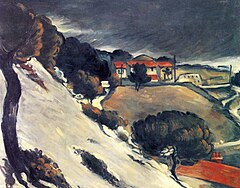
Paul Cézanne, Fifty'Estaque, Melting Snow, c. 1871. Writer Ronald Berman draws comparing betwixt Cézanne's handling of this landscape and the way Hemingway imbues the Irati River with emotional texture. In both, the landscape is a subjective element seen differently past each character.[93]
The simplicity of his style is deceptive. Bloom writes that it is the constructive utilise of parataxis that elevates Hemingway'due south prose. Drawing on the Bible, Walt Whitman and Adventures of Blueberry Finn, Hemingway wrote in deliberate understatement and he heavily incorporated parataxis, which in some cases nigh becomes cinematic.[94] His skeletal sentences were crafted in response to Henry James's ascertainment that Globe War I had "used up words," explains Hemingway scholar Zoe Trodd, who writes that his mode is similar to a "multi-focal" photographic reality. The syntax, which lacks subordinating conjunctions, creates static sentences. The photographic "snapshot" way creates a collage of images. Hemingway omits internal punctuation (colons, semicolons, dashes, parentheses) in favor of brusque declarative sentences, which are meant to build, as events build, to create a sense of the whole. He besides uses techniques analogous to cinema, such as cutting quickly from 1 scene to the next, or splicing 1 scene into another. Intentional omissions permit the reader to fill the gap as though responding to instructions from the author and create 3-dimensional prose.[95] Biographer James Mellow writes that the bullfighting scenes are presented with a crispness and clarity that evoke the sense of a newsreel.[96]
Hemingway as well uses colour and visual art techniques to convey emotional range in his descriptions of the Irati River. In Translating Modernism: Fitzgerald and Hemingway, Ronald Berman compares Hemingway's handling of landscape with that of the post-Impressionist painter Paul Cézanne. During a 1949 interview, Hemingway told Lillian Ross that he learned from Cézanne how to "brand a landscape." In comparing writing to painting he told her, "This is what we effort to do in writing, this and this, and woods, and the rocks we have to climb over."[97] The landscape is seen subjectively—the viewpoint of the observer is paramount.[98] To Jake, mural "meant a search for a solid class .... not existentially present in [his] life in Paris."[98]
Reception [edit]
Hemingway's first novel was arguably his best and most important and came to be seen equally an iconic modernist novel, although Reynolds emphasizes that Hemingway was not philosophically a modernist.[99] In the book, his characters epitomized the post-war expatriate generation for future generations.[100] He had received good reviews for his volume of short stories, In Our Time, of which Edmund Wilson wrote, "Hemingway's prose was of the kickoff distinction." Wilson'south comments were enough to bring attention to the young writer.[101]
No amount of analysis can convey the quality of The Sun Too Rises. It is a truly gripping story, told in a lean, difficult, athletic narrative prose that puts more literary English to shame. Mr. Hemingway knows how non simply to make words be specific merely how to arrange a collection of words which shall betray a great deal more than is to be establish in the individual parts. It is magnificent writing. —The New York Times review of The Sun Besides Rises, 31 Oct 1926.[102]
Good reviews came in from many major publications. Conrad Aiken wrote in the New York Herald Tribune, "If there is a better dialogue to be written today I do not know where to find it"; and Bruce Barton wrote in The Atlantic that Hemingway "writes as if he had never read everyone'southward writing, as if he had fashioned the art of writing himself," and that the characters "are amazingly real and alive."[20] Many reviewers, amidst them H.L. Mencken, praised Hemingway's style, apply of understatement, and tight writing.[103]
Other critics, withal, disliked the novel. The Nation 's critic believed Hemingway'due south hard-boiled style was better suited to the short stories published in In Our Time than his novel. Writing in the New Masses, Hemingway's friend John Dos Passos asked: "What'southward the thing with American writing these days? .... The few unsad young men of this lost generation will have to look for another manner of finding themselves than the one indicated hither." Privately he wrote Hemingway an apology for the review.[20] The reviewer for the Chicago Daily Tribune wrote of the novel, "The Sun Also Rises is the kind of volume that makes this reviewer at least almost patently angry."[104] Some reviewers disliked the characters, amid them the reviewer for The Dial, who thought the characters were shallow and vapid; and The Nation and Atheneum deemed the characters deadening and the novel unimportant.[103] The reviewer for The Cincinnati Enquirer wrote of the book that information technology "begins nowhere and ends in nix."[i]
Hemingway's family unit hated it. His mother, Grace Hemingway, distressed that she could non confront the criticism at her local volume study class—where it was said that her son was "prostituting a nifty ability .... to the lowest uses"—expressed her displeasure in a letter to him:
The critics seem to exist full of praise for your fashion and ability to draw discussion pictures but the decent ones always regret that you lot should use such great gifts in perpetuating the lives and habits of and then degraded a strata of humanity .... Information technology is a doubtful accolade to produce i of the filthiest books of the year .... What is the matter? Have yous ceased to be interested in dignity, honor and fineness in life? .... Surely you have other words in your vocabulary than "damn" and "bowwow"—Every page fills me with a ill loathing.[105]
Even so, the book sold well, and immature women began to emulate Brett while male person students at Ivy League universities wanted to get "Hemingway heroes." Scribner's encouraged the publicity and allowed Hemingway to "become a modest American phenomenon"—a celebrity to the betoken that his divorce from Richardson and marriage to Pfeiffer attracted media attention.[106]
Reynolds believes The Sun Also Rises could take been written but circa 1925: it perfectly captured the period between World War I and the Great Depression, and immortalized a group of characters.[107] In the years since its publication, the novel has been criticized for its antisemitism, as expressed in the label of Robert Cohn. Reynolds explains that although the publishers complained to Hemingway about his description of bulls, they allowed his use of Jewish epithets, which showed the caste to which antisemitism was accepted in the U.s. later on World War I. Cohn represented the Jewish establishment and contemporary readers would have understood this from his description. Hemingway clearly makes Cohn unlikeable not just as a character but every bit a character who is Jewish.[108] Critics of the 1970s and 1980s considered Hemingway to be misogynistic and homophobic; by the 1990s his work, including The Sun Likewise Rises, began to receive critical afterthought by female scholars.[109]
Legacy and adaptations [edit]
Hemingway'southward work connected to be popular in the latter half of the century and afterward his suicide in 1961. During the 1970s, The Dominicus Also Rises appealed to what Beegel calls the lost generation of the Vietnam era.[110] Aldridge writes that The Sun Besides Rises has kept its appeal because the novel is about beingness young. The characters alive in the most beautiful metropolis in the earth, spend their days traveling, fishing, drinking, making beloved, and generally reveling in their youth. He believes the expatriate writers of the 1920s appeal for this reason, but that Hemingway was the most successful in capturing the time and the place in The Sunday Likewise Rises.[111]
Blossom says that some of the characters have non stood the test of time, writing that modern readers are uncomfortable with the antisemitic treatment of Cohn's character and the romanticization of a bullfighter. Moreover, Brett and Mike belong uniquely to the Jazz Age and do not interpret to the modern era. Bloom believes the novel is in the canon of American literature for its formal qualities: its prose and style.[112]
The novel fabricated Hemingway famous, inspired young women across America to wearable short hair and sweater sets like the heroine's—and to act like her too—and changed writing style in ways that could be seen in any American magazine published in the next 20 years. In many ways, the novel's stripped-downward prose became a model for 20th-century American writing. Nagel writes that "The Sun Also Rises was a dramatic literary event and its effects accept not diminished over the years."[113]
The success of The Sun Also Rises led to interest from Broadway and Hollywood. In 1927 2 Broadway producers wanted to conform the story for the stage but made no firsthand offers. Hemingway considered marketing the story directly to Hollywood, telling his editor Max Perkins that he would not sell it for less than $30,000—money he wanted his estranged wife Hadley Richardson to have. Conrad Aiken thought the book was perfect for a film adaptation solely on the forcefulness of dialogue. Hemingway would not run into a stage or film adaption someday soon:[114] he sold the film rights to RKO Pictures in 1932,[115] merely just in 1956 was the novel adapted to a film of the same proper name. Peter Viertel wrote the screenplay. Tyrone Ability equally Jake played the lead part opposite Ava Gardner equally Brett and Errol Flynn as Mike. The royalties went to Richardson.[116]
Hemingway wrote more books most bullfighting: Expiry in the Afternoon was published in 1932 and The Unsafe Summer was published posthumously in 1985. His depictions of Pamplona, first with The Lord's day Also Rises, helped to popularize the annual running of the bulls at the Festival of St. Fermin.[117]
References [edit]
- ^ The Torrents of Spring has little scholarly criticism as it is considered to be of less importance than Hemingway's subsequent work. Run across Oliver (1999), 330
- ^ Hemingway may have used the term as an early on title for the novel, according to biographer James Mellow. The term originated from a remark in French made to Gertrude Stein by the owner of a garage, speaking of those who went to war: "C'est une génération perdue" (literally, "they are a lost generation"). See Mellow (1992), 309
- ^ Hemingway wrote a fragment of an unpublished sequel in which he has Jake and Brett meeting in the Dingo Bar in Paris. With Brett is Mike Campbell. See Daiker (2009), 85
- ^ "Employ brusque sentences. Employ short beginning paragraphs. Use vigorous English language. Be positive, non negative."
Citations [edit]
- ^ a b c Leff (1999), 51
- ^ Meyers (1985), 192
- ^ Wagner-Martin (1990), one
- ^ a b Bakery (1972), 82
- ^ Meyers (1985), 98–99
- ^ Meyers (1985), 117–119
- ^ a b Balassi (1990), 128
- ^ a b Nagel (1996), 89
- ^ Chapter ix references the Ledoux-Kid fight which took place ix June 1925. Link Chapter 15 references Lord's day the 6th of July which must be 1924 which easily tin be verified by an online calendar or by Linux users with the command cal -y 1924.
- ^ Meyers (1985), 189
- ^ Balassi (1990), 132, 142, 146
- ^ Reynolds (1989), vi–seven
- ^ Meyers (1985), 172
- ^ Baker (1972), 44
- ^ Mellow (1992), 338–340
- ^ Mellow (1992), 317–321
- ^ Bakery (1972), 76, 30–34
- ^ Oliver (1999), 318
- ^ qtd. in Leff (1999), 51
- ^ a b c Mellow (1992), 334–336
- ^ Leff (1999), 75
- ^ White (1969), 4
- ^ Reynolds (1999), 154
- ^ McDowell, Edwin, "Hemingway's Condition Revives Among Scholars and Readers". The New York Times (July 26, 1983). Retrieved 27 February 2011
- ^ "Books at Random House" Archived 2010-05-xvi at the Wayback Car. Random House. Retrieved 31 May 2011.
- ^ "Hemingway books coming out in audio editions" MSNBC.com (February fifteen, 2006). Retrieved 27 February 2011.
- ^ Crouch, Ian, Hemingway'southward Hidden Metafictions. The New Yorker (7 Baronial 2014).
- ^ Hemingway, Ernest (2014). The Lord's day Likewise Rises. ISBN978-i-4767-3995-3.
- ^ Reynolds (1990), 48–49
- ^ Oliver (1999), 316–318
- ^ Meyers (1985), 191
- ^ Ecclesiastes ane:three–5, Male monarch James Version.
- ^ a b c d east f chiliad h Wagner-Martin (1990), half dozen–9
- ^ Reynolds (1990), 62–63
- ^ Reynolds (1990), 45–fifty
- ^ Reynolds (1990), 60–63
- ^ Reynolds (1990), 58–59
- ^ a b Nagel (1996), 94–96
- ^ Daiker (2009), 74
- ^ Nagel (1996), 99–103
- ^ Meyers (1985), 190
- ^ Fore (2007), fourscore
- ^ a b c Fiedler (1975), 345–365
- ^ Baym (1990), 112
- ^ qtd. in Reynolds (1990), 60
- ^ Daiker (2009), 80
- ^ Donaldson (2002), 82
- ^ Daiker (2009), 83
- ^ a b Balassi (1990), 144–146
- ^ Reynolds (1989), 323–324
- ^ a b qtd. in Balassi (1990), 127
- ^ Müller (2010), 31–32
- ^ a b Kinnamon (2002), 128
- ^ Josephs (1987), 158
- ^ a b Stoltzfus (2005), 215–218
- ^ Reynolds (1989), 320
- ^ Josephs (1987), 163
- ^ Bloom (2007), 31
- ^ Djos (1995), 65–68
- ^ Balassi (1990), 145
- ^ Reynolds (1990), 56–57
- ^ Elliot (1995), 80–82
- ^ Elliot (1995), 86–88
- ^ Elliot (1995), 87
- ^ Mellow (1992), 312
- ^ Davidson (1990), 97
- ^ Fore (2007), 75
- ^ Hemingway (2006 ed), 214
- ^ a b Oliver (1999), 270
- ^ Gross, Barry (December 1985). ""Yours Sincerely, Sinclair Levy"". Commentary, The monthly magazine of opinion. Archived from the original on xix March 2022. Retrieved 19 March 2022.
- ^ Beegel (1996), 288
- ^ Knopf (1987), 68–69
- ^ Reynolds (1989), 297
- ^ a b Wagner-Martin (1990), ii–four
- ^ Meyers (1985), lxx–74
- ^ Hallengren, Anders. "A Case of Identity: Ernest Hemingway", Nobelprize.org. Retrieved 15 April 2011.
- ^ Wagner-Martin (2002), vii
- ^ Wagner-Martin (1990), 11–12
- ^ Hemingway (2006 ed), 221
- ^ qtd. in Balassi (1990), 138
- ^ Balassi (1990), 138
- ^ Baker (1987), 11
- ^ Mellow (1992), 303
- ^ Svoboda (1983), nine
- ^ Benson (1989), 351
- ^ Oliver (1999), 321–322
- ^ qtd. in Oliver (1999), 322
- ^ Balassi (1990), 136
- ^ Balassi (1990), 125, 136, 139–141
- ^ Balassi (1990), 150; Svoboda (1983), 44
- ^ "Star style and rules for writing" Archived 2014-04-08 at the Wayback Auto. The Kansas City Star. KansasCity.com. Retrieved 15 April 2011.
- ^ Aldridge (1990), 126
- ^ Berman (2011), 59
- ^ Blossom (1987), 7–eight
- ^ Trodd (2007), 8
- ^ Mellow (1992), 311
- ^ Berman (2011), 52
- ^ a b Berman (2011), 55
- ^ Wagner-Martin (1990), one, 15; Reynolds (1990), 46
- ^ Mellow (1992), 302
- ^ Wagner-Martin (2002), 4–5
- ^ "The Sun Also Rises". (October 31, 1926) The New York Times. Retrieved 13 March 2011.
- ^ a b Wagner-Martin (2002), 1–2
- ^ qtd. in Wagner-Martin (1990), one
- ^ qtd. in Reynolds (1998), 53
- ^ Leff (1999), 63
- ^ Reynolds (1990), 43
- ^ Reynolds (1990), 53–55
- ^ Bloom (2007), 28; Beegel (1996), 282
- ^ Beegel (1996), 281
- ^ Aldridge (1990), 122–123
- ^ Bloom (1987), v–half dozen
- ^ Nagel (1996), 87
- ^ Leff (1999), 64
- ^ Leff (1999), 156
- ^ Reynolds (1999), 293
- ^ Palin, Michael. "Lifelong Aficionado" and "San Fermín Festival". in Michael Palin's Hemingway Hazard. PBS.org. Retrieved 23 May 2011.
Sources [edit]
- Aldridge, John W. (1990). "Afterthought on the Twenties and The Lord's day Too Rises". in Wagner-Martin, Linda (ed). New Essays on Sunday Also Rises. New York: Cambridge Upward. ISBN 978-0-521-30204-three
- Baker, Carlos (1972). Hemingway: The Writer as Artist. Princeton: Princeton Upward. ISBN 978-0-691-01305-3
- Bakery, Carlos (1987). "The Wastelanders". in Blossom, Harold (ed). Modern Critical Interpretations: Ernest Hemingway's "The Sun As well Rises". New York: Chelsea House. ISBN 978-1-55546-053-ii
- Balassi, William (1990). "Hemingway'southward Greatest Iceberg: The Composition of The Dominicus Also Rises". in Barbour, James and Quirk, Tom (eds). Writing the American Classics. Chapel Hill: Northward Carolina UP. ISBN 978-0-8078-1896-1
- Baym, Nina (1990). "Really I Felt Distressing for the Panthera leo". in Benson, Jackson J. (ed). New Disquisitional Approaches to the Brusk Stories of Ernest Hemingway. Durham: Duke Upward. ISBN 978-0-8223-1067-9
- Beegel, Susan (1996). "Conclusion: The Disquisitional Reputation". in Donaldson, Scott (ed). The Cambridge Companion to Ernest Hemingway. New York: Cambridge UP. ISBN 978-0-521-45574-nine
- Benson, Jackson (1989). "Ernest Hemingway: The Life as Fiction and the Fiction as Life". American Literature. 61 (3): 354–358
- Berman, Ronald (2011). Translating Modernism: Fitzgerald and Hemingway. Tuscaloosa: Alabama Upwardly. ISBN 978-0-8173-5665-1
- Bloom, Harold (1987). "Introduction". in Bloom, Harold (ed). Modern Disquisitional Interpretations: Ernest Hemingway'due south "The Sun Also Rises". New York: Chelsea House. ISBN 978-one-55546-053-2
- Bloom, Harold (2007). "Introduction". in Flower, Harold (ed). Ernest Hemingway's "The Sun Also Rises". New York: Infobase Publishing. ISBN 978-0-7910-9359-vii
- Daiker, Donald (2009). "Lady Ashley, Pedro Romero and the Madrid Sequence of The Sun Also Rises". The Hemingway Review. 29 (1): 73–86
- Davidson, Cathy and Arnold (1990). "Decoding the Hemingway Hero in The Sun Also Rises". in Wagner-Martin, Linda (ed). New Essays on Dominicus Too Rises. New York: Cambridge Upward. ISBN 978-0-521-30204-3
- Djos, Matt (1995). "Alcoholism in Ernest Hemingway's The Sun Also Rises". The Hemingway Review. 14 (2): 64–78
- Donaldson, Scott (2002). "Hemingway's Morality of Compensation". in Wagner-Martin, Linda (ed). Ernest Hemingway'due south The Lord's day Also Rises: A Casebook. New York: Oxford UP. ISBN 978-0-xix-514573-1
- Elliot, Ira (1995). "Operation Art: Jake Barnes and Masculine Signification in The Sun Besides Rises". American Literature. 63 (1): 77–94
- Fiedler, Leslie (1975). Dear and Expiry in the American Novel. New York: Stein and 24-hour interval. ISBN 978-0-8128-1799-vii
- Fore, Dana (2007). "Life Unworthy of Life? Masculinity, Disability, and Guilt in The Dominicus Likewise Rises. The Hemingway Review. sixteen (1): 75–88
- Hays, Peter L., ed. (2007). "Teaching Hemingway'due south The Sun As well Rises." Kent, OH: The Kent State University Press.
- Hemingway, Ernest (1926). The Sunday Too Rises. New York: Scribner. 2006 edition. ISBN 978-0-7432-9733-2
- Josephs, Allen (1987). "Torero: The Moral Centrality of The Sun Also Rises". in Bloom, Harold (ed). Modernistic Critical Interpretations: Ernest Hemingway's "The Lord's day Likewise Rises". New York: Chelsea House. ISBN 978-1-55546-053-ii
- Kinnamon, Keneth (2002). "Hemingway, the Corrida, and Spain". in Wagner-Martin, Linda (ed). Ernest Hemingway's The Sun Also Rises: A Casebook. New York: Oxford UP. ISBN 978-0-19-514573-1
- Knopf, Josephine (1987). "Meyer Wolfsheim and Robert Cohn: A Report of a Jew Blazon and Sterotype". in Bloom, Harold (ed). Modern Disquisitional Interpretations: Ernest Hemingway'southward The Sun Likewise Rises". New York: Chelsea Business firm. ISBN 978-1-55546-053-2
- Leff, Leonard (1999). Hemingway and His Conspirators: Hollywood, Scribner's and the making of American Celebrity Civilisation. Lanham: Rowman & Littlefield. ISBN 978-0-8476-8545-five
- Mellow, James (1992). Hemingway: A Life Without Consequences. Boston: Houghton Mifflin. ISBN 978-0-395-37777-2
- Meyers, Jeffrey (1985). Hemingway: A Biography. New York: Macmillan. ISBN 978-0-333-42126-0
- Müller, Timo (2010). "The Uses of Authenticity: Hemingway and the Literary Field, 1926–1936". Periodical of Modern Literature. 33 (1): 28–42
- Nagel, James (1996). "Brett and the Other Women in The Lord's day Besides Rises". in Donaldson, Scott (ed). The Cambridge Companion to Ernest Hemingway. New York: Cambridge Upwardly. ISBN 978-0-521-45574-9
- Oliver, Charles (1999). Ernest Hemingway A to Z: The Essential Reference to the Life and Piece of work. New York: Checkmark Publishing. ISBN 978-0-8160-3467-3
- Reynolds, Michael (1990). "Recovering the Historical Context". in Wagner-Martin, Linda (ed). New Essays on Sun As well Rises. New York: Cambridge UP. ISBN 978-0-521-30204-3
- Reynolds, Michael (1999). Hemingway: The Concluding Years. New York: Norton. ISBN 978-0-393-32047-3
- Reynolds, Michael (1989). Hemingway: The Paris Years. New York: Norton. ISBN 978-0-393-31879-one
- Reynolds, Michael (1998). The Young Hemingway. New York: Norton. ISBN 978-0-393-31776-3
- Stoltzfus, Ben (2005). "Sartre, "Nada," and Hemingway's African Stories". Comparative Literature Studies. 42 (3): 228–250
- Stoneback, H.R. (2007). "Reading Hemingway's The Sunday Too Rises: Glossary and Commentary." Kent, OH: The Kent State Upward.
- Svoboda, Frederic (1983). Hemingway & The Sun Also Rises: The Crafting of a Style. Lawrence: Kansas UP. ISBN 978-0-7006-0228-5
- Trodd, Zoe (2007). "Hemingway'south Camera Eye: The Problems of Language and an Interwar Politics of Form". The Hemingway Review. 26 (ii): 7–21
- Wagner-Martin, Linda (2002). "Introduction". in Wagner-Martin, Linda (ed). Ernest Hemingway's The Sun Too Rises: A Casebook. New York: Oxford UP. ISBN 978-0-19-514573-1
- Wagner-Martin, Linda (1990). "Introduction". in Wagner-Martin, Linda (ed). New Essays on Sun Also Rises. New York: Cambridge UP. ISBN 978-0-521-30204-iii
- White, William (1969). The Merrill Studies in The Lord's day Also Rises. Columbus: C. E. Merrill.
- Immature, Philip (1973). Ernest Hemingway. St. Paul: Minnesota Upward. ISBN 978-0-8166-0191-2
External links [edit]
Source: https://en.wikipedia.org/wiki/The_Sun_Also_Rises
0 Response to "And the Sun Shall Rise Again"
Post a Comment