Is Reading a Story Without Pictures a Constructivism
Summary
- Mandatory task: no
- Word count: around 100 words
- Main characteristics: interesting/engaging linguistic communication, clear structure, specific linguistic communication
- Structure: beginning, main part, ending
- Language: interesting adjectives & adverbs, past verb forms, direct oral communication, time expressions
- Case
Every bit the plane flew lower, Lou saw the golden beaches of the island below. The sun was shining brightly and he said to the woman next to him, "I'm and so excited about my holidays!"
As shortly equally Lou got off the plane he left the airdrome and took a taxi to the metropolis centre because he actually wanted to swim in the articulate water and sunbathe on the beautiful beach he had seen earlier.
However, when he arrived at the beach he saw that the atmospheric condition was changing and 5 minutes later it was raining heavily. Lou ran into a bar and was surprised because someone shouted, "Hi, it's you again!"
At that place was the woman from the plane! They started to talk and became very good friends.
Introduction
Part 1 of the the Writing exam in B1 Preliminary is always an email. You lot can't cull this task, but in the second part of the test y'all can decide if y'all want to write an commodity or a story.
In every story task you lot go one judgement which has to be the first sentence of your story and the text has to be related to this. Your language should exist neutral to breezy.
>>> Notice out how to write an amazing e-mail for PET here. <<<
>>> For cracking data on PET article writing click here. <<<
What does a typical story task look similar?
Whenever you get ready for a writing task in the PET examination, you demand to think nigh a few questions. These questions help you understand the job improve and brand a program for your story.
- What is the situation?
- What do I have to include in my story?
- Who is going to read my story?
Let's have a await at a typical example task and encounter how we can answer the questions above.
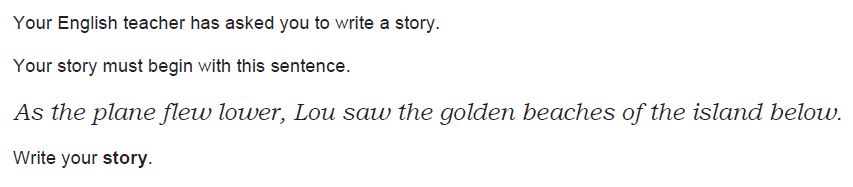
Yous can see that at that place isn't a lot of data, but nosotros still have to cheque the task very advisedly so nosotros know exactly what to do.
In the given judgement a person called Lou is on a plane flying over an island and he's looking at the beaches. The plane is going lower so information technology might be getting set up to country. This is the situation you lot have to commencement your story from and everything you write has to be related to this offset.
The second question is a trivial chip more open than the first ane because yous tin can pretty much write about annihilation y'all like. The only restriction, again, is the first judgement and the situation that comes with it. You can brand your story funny, lamentable, full of action or fantasy and include whatever yous can imagine, just connect information technology to the first sentence.
Terminal but not least, your English teacher is going to read your story. In other writing tasks you need to be very conscientious with your language, merely in a story you are freer. You decide if your characters use very formal English or if they are breezy. Just recall, don't use rude language or words that are not in the dictionary.
You run across, there is a lot of freedom that you have when you write a story, but, at the same time, y'all have to brand certain that you focus on the topic in the first sentence and that you are careful with your language considering the rules are not as strict as in an email or article.
How to organise your story
The good matter about B1 Preliminary writing tasks is that you lot can always organise them in the same way. It is a little bit like a practiced cooking recipe considering it works every time.
A adept story usually has a beginning, a main part and an ending. The principal part is the most of import 1 so you want make it longer than the other parts. Most of the time, we go to a construction that looks like this:
- Outset sentence / Beginning
- Principal part paragraph i
- Principal part paragraph 2
- Ending
Of course, you might have 3 master office paragraphs, but in most tasks the structure with simply two works very well.
Always program your story
If y'all start to write your story without thinking about it starting time, you might run into some large problems. You can't really change everything once you lot've started considering you but have 45 minutes to write your story AND an e-mail.
That's why yous should always make a program. Utilize the structure above and merely add a few ideas so it works like a map. You will know exactly where your story is going and you only have to worry most using skillful linguistic communication.
The different parts of a story
Now, nosotros are going to observe out what the different parts of a story typically look like and I will requite yous some useful tips about skilful linguistic communication that will help you get skillful marks.
First sentence / Showtime
Equally I said above, in a PET story you ever have to start with a sentence that you become directly from the task. Don't alter this judgement in any manner, merely but copy it onto you answer sheet and begin your story from there.
I recommend calculation one more sentence to complete the commencement of your story. For our example job this could look like this:
Every bit the plane flew lower, Lou saw the golden beaches of the island below. The lord's day was shining brightly and he said to the woman next to him, "I'thousand so excited nigh my holidays!"
When we look at the first judgement from the task, at that place are a couple of things that are non 100% clear. For instance, why was Lou on the aeroplane? What island did he see? Why did the airplane fly lower? In my second judgement I tried to make things a little chip clearer. Lou was on his way to spend his holidays on the island and the plane was getting set up for landing.
In terms of proficient linguistic communication, I used by continuous (was shining), which nosotros use to say what was happening in the background or at the same time every bit our primary events. I also included an adverb (brightly) and an adjective (golden), which makes an activity more interesting, and in that location is some direct speech ("I'm so excited about my holidays!"). This brings the reader closer to the characters compared to indirect or reported speech.
Always try to make certain to gear up the scene. Give some background information (past continuous) to introduce the primary character(s). Add some adjectives and adverbs as well as straight speech because this makes the reader experience more interested in your story and they want to keep reading.
Main paragraphs
Once we fix the scene, we can move on to the main role of the story. Here, nosotros endeavour to develop the plot and all the main events happen in these paragraphs. Yous can determine how many paragraphs you want to make, but in full general you lot should exist fine with ii or 3 of them.
For our case task I chose two paragraphs:
As soon every bit Lou got off the aeroplane he left the airport and took a taxi to the metropolis centre because he really wanted to swim in the articulate h2o and sunbathe on the beautiful beach he had seen before.
However, when he arrived at the embankment he saw that the conditions was irresolute and five minutes after it was raining heavily. Lou ran into a bar and was surprised because someone shouted, "Hi, information technology'due south you lot again!"
I tried to let the plot abound a little scrap in my outset master paragraph and, at the aforementioned time, create some excitement for the reader. Lou wants to get to the beach, but when I employ the discussion 'notwithstanding' to starting time the second paragraph, information technology is clear that something must be wrong. Finally, I finish my main paragraphs with a mysterious vocalisation calling for Lou in the bar. The reader wants to know how the story ends.
For useful linguistic communication, you lot can find some time expressions (equally shortly every bit, when, five minutes later) as well as past perfect and past continuous (had seen, was irresolute, was raining). These verb forms help us to give extra information around the main events of the story. In add-on, there are interesting adjectives (articulate, beautiful, surprised) and adverbs (really, heavily). In one case once again, these words help usa make our story more interesting for the reader.
It is besides a skilful idea to use some contrast (however) and surprising elements (someone shouted) in your story because, again, you want to make the story every bit interesting equally possible.
Ending
Every proficient story has an ending. In PET, you want to end your story in a surprising and/or funny way so the reader is happy.
Make certain that the ending is connected to the topic. Don't introduce new characters or let the story move in a completely different direction. Merely write one or ii final sentences and that's it.
In my example story I wrote this:
In that location was the woman from the aeroplane! They started to talk and became very expert friends.
Information technology's a short ending with a little surprising element (the woman from the plane). Information technology is zero special or crazy, merely it brings the whole story together in a nice manner. That's all you have to do to brand the examiner happy and become great marks.
Useful language for PET story writing
In this office I'thou going to give you lot a summary of the different types of useful language for your Cambridge B1 story.
Past verb forms
Past simple, by continuous and past perfect are the three most important verb forms when you write a story.
- Past simple describes the principal events of your story.
- Past continuous describes what was happening at the same time every bit the primary events.
- Past perfect describes what happened before the chief events.
Study these verb tenses and practise as much as y'all can.
Fourth dimension expressions
Time expressions put the events of your story in a sequence. When yous apply them in the right way, the reader understands what happened first and the sequence of events.
Some examples of time expressions that you can use in almost every story are:
- when
- equally soon as
- immediately
- before
- earlier
- until
- while
- after that
- adjacent (twenty-four hours/morning etc.)
- x minutes/days/years later
Use one or two of these in every paragraph so the examiner is happy and gives you high marks. 🙂
Adjectives and adverbs
Adjectives and adverbs are like different spices in your food. Without them everything tastes a picayune bit boring and then nosotros want to make it equally flavourful as possible. Just as with time expressions, always retrieve near where you can use adjectives and adverbs to describe a person, an object, a place or an activity in more detail.
Look again at my story with all the adjectives and adverbs highlighted:
As the aeroplane flew lower, Lou saw the gold beaches of the island below. The sun was shining brightly and he said to the adult female next to him, "I'chiliad so excited about my holidays!"
As soon equally Lou got off the aeroplane he left the airport and took a taxi to the city middle because he really wanted to swim in the clear water and sunbathe on the beautiful embankment he had seen before.
However, when he arrived at the beach he saw that the weather was changing and five minutes later it was raining heavily. Lou ran into a bar and was surprised because someone shouted, "Howdy, information technology's you lot again!"
There was the woman from the plane! They started to talk and became very skillful friends.
You meet that I didn't overuse adjective and adverbs, but two or three in every paragraph are already going to improve your story a lot.
Direct speech
Directly speech describes the things that somebody actually says in that moment. We always use quotation marks (") to show that we are using direct speech.
Used in a story it gives the reader the feeling of existence closer to the activity and the characters experience more alive. Always endeavor to have a couple of sentences in direct oral communication in your stories.
My examples are:
- …he said to the woman next to him, "I'm so excited about my holidays!"
- …someone shouted, "Hi, it's you again!"
Practise makes perfect
It is now your turn to practice story writing. Don't look until information technology is too late. With every story y'all write you volition feel more confident and gear up for the exam. Practise the different kinds of useful language and footstep by step you will improve.
I hope my article volition help you and if you enjoy my content, exit a comment and permit me know what you lot recollect.
Lots of beloved,
Teacher Phill 🙂
Source: https://teacherphill.com/pet-how-to-write-a-story/
0 Response to "Is Reading a Story Without Pictures a Constructivism"
Post a Comment