How Do Cats Get Worms Again
The nigh common intestinal worms cats go are called roundworms and tapeworms. Most infected cats do not bear witness signs of having worms; however, heavy burdens of worms tin crusade weight loss, vomiting and diarrhoea, irritation around the anus and failure to thrive.
Importantly, while worms can sometimes crusade issues for the cat itself, some worms can too be passed on to humans and on rare occasions tin be a cause of serious human being affliction. For these reasons, regular treatment of cats and kittens to forbid or eliminate worms is very important.
Types of worms
Roundworms
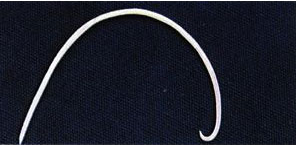
Intestinal roundworms are the most common abdominal parasites in cats and occur in cats of all ages throughout the world. The two mutual roundworms of cats are called, Toxocara cati and Toxascaris leonina. Eggs from these worms are passed in the faeces and can remain viable in the environment for several years. These eggs can infect other cats in two ways. First, a cat may swallow (ingest) eggs directly from a contaminated environment. Second, if another animal eats the eggs (eg, a mouse or rat), these can act as 'intermediate hosts' and pass on the infection to a cat if information technology preys on (and eats) the infected intermediate host.
Toxocara cati is too passed from queens (mother cats) to kittens through the milk she produces. Whenever a cat is infected with roundworms, some immature forms (larvae) remain dormant in tissues in the body. This unremarkably causes no harm, but when a female person cat becomes pregnant, these larvae migrate to the mammary glands and are excreted in the milk she produces for the kittens. This is a very mutual route of infection and we should assume that every kitten volition exist infected with Toxocara cati as a result.
In most cases, regular routine treatment for roundworms is recommended throughout a true cat's life. Nevertheless, to determine if a cat is actually infected with worms, a faeces sample can be nerveless and examined in the laboratory to expect for the presence of the worm eggs.
Other gastro-intestinal roundworms that may infect cats in various parts of the earth include:
- Ollulanus tricuspis (found in the stomach)
- Gnathostoma spp
- Physaloptera spp
- Strongyloides spp
Hookworms
Hookworms are a type of small abdominal roundworm found in most countries throughout the world, but are more than mutual in some countries than others. These worms tin cause damage to the lining of the intestine where they attach to the surface, and this may result in weight loss, bleeding and anaemia.
Cats may be infected past ingestion (eating) eggs from the surround, from eating an infected intermediate host (as with Toxocara cati higher up) or by the larvae in the environment burrowing through the cat'due south skin.
Common true cat hookworms include Ancylostoma tubaeforme, and Uncinaria stenocephala, but other species occur in some countries.
Tapeworms

Tapeworms are generally long flat worms equanimous of many segments. Mature segments containing eggs are released from the end of the tapeworm and are passed in the faeces. These segments often resemble grains of rice and can sometimes be seen on the pilus around the anus of the cat, in the faeces and on the cat's bed.
To complete their life-cycle, all tapeworms crave an intermediate host to get-go eat the eggs from the environment, and so the cat will become infected past eating the intermediate host. Animals that human activity as intermediate hosts vary depending on the species of tapeworm. The almost common tapeworms that infect cats worldwide are Dipylidium caninum and Taenia taeniaeformis.
Dipylidium caninum is transmitted to cats by fleas. The immature fleas larvae ingest the eggs of the worm, just infection is then passed on to a cat when it swallows an infected flea during training. It should be causeless that any cat infected with fleas also has Dipylidium caninum (and vice versa).
Taenia taeniaeformis is passed on when they consume pocket-size rodents (rats and mice), the rodents having eaten eggs from the environment. This infection occurs very commonly in cats that chase.
Other tapeworms that occur in some countries include:
- Diphylobothrium latum (fish are intermediate hosts)
- Spirometra spp (amphibian, reptiles and rodents are intermediate hosts)
- Diplopylidium spp (reptiles are intermediate hosts)
- Joyeuxiella spp (reptiles are intermediate hosts)
- Echinococcus multilocularis (rodents are intermediate hosts)
Worming your cat
Roundworms are extremely common in kittens, and as kittens tin be infected from the mother's milk it should be assumed that all kittens are infected and worming should be started at a young age. Common recommendations are to:
- Treat kittens for roundworms every 2 weeks from 3 weeks of historic period until 8 weeks of age, then monthly to half-dozen months of age
- Treat adult cats (greater than 6 months of age) every 1-3 months
Tapeworms are only usually a trouble in older cats, unless a kitten also has fleas.
- Care for adult cats (greater than 6 months of age) every 1-iii months with a production that is effective confronting both tapeworms and roundworms.
A product agile against Dipylidium caninum should also be used in kittens that have flea infestations.
Which worming products to utilize?
In that location are many different worming products available on the market, and drug availability varies between different countries. While worming products may be available from pet shops and even some supermarkets, these are often former or less effective products and some are even less safety to use in cats.
It is always better to seek the advice of your vet, who will know what types of worms occur usually where you live, and volition be able to recommend the most effective and safest treatments for your cat. Additionally, some treatments are bachelor which may exist easier to administer, such as an injection that your vet can requite, a tiny tablet that can go in with food, or even some drops that tin can be practical to the pare.
Come across besides our data on how to requite your cat a tablet.
Other worms
In addition to intestinal worms, cats tin be infected with a diverseness of other worms in other sites of the body, although often these worms are not present in all regions of the world. These include:
- Dirofilaria immitis – heartworm
- Aelurostrongylus abstrusus – lungworm
- Capillaria spp – lungworm
- Thelazia callipaeda – eyeworm
Cheers for visiting our website, we hope you have found our information useful.
All our communication is freely accessible to everyone, wherever you are in the world. Notwithstanding, as a charity, we need your support to enable us to proceed delivering high quality and upward to appointment information for everyone. Please consider making a contribution, big or small-scale, to keep our content free, accurate and relevant.
Back up International Cat Care from as piffling £iii
Thank you.
Donate Now
Source: https://icatcare.org/advice/worming-your-cat/
0 Response to "How Do Cats Get Worms Again"
Post a Comment